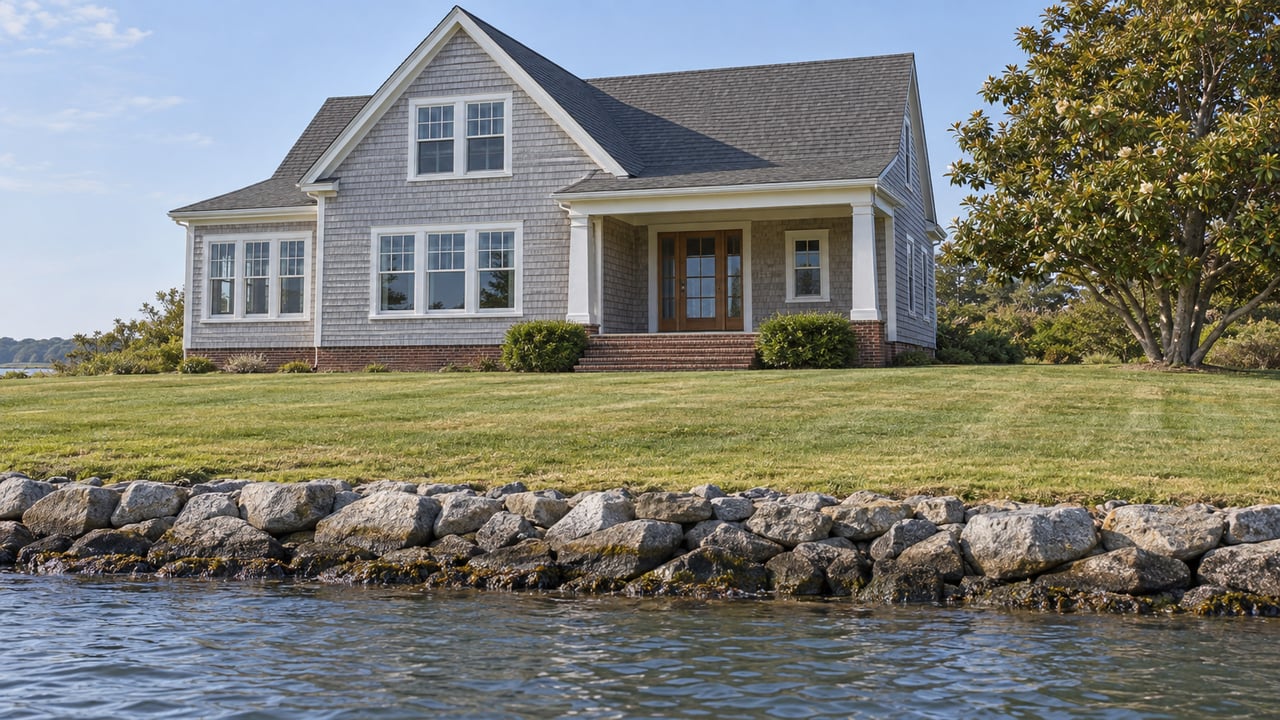
A buyer touring Carter's Creek this fall might assume the dock comes with the house the way a driveway does: it is there, it works, and if the current one has problems, a contractor can just build a new one. That assumption breaks down faster in Irvington than in most towns, because the water and the paperwork attached to any given waterfront parcel are not interchangeable the way the walls and roof are.
As of late September 2026, only four waterfront homes are listed for sale in Irvington, with a median price of $625,000 and just one sale recorded in the past month, based on current listing-site figures. Compare that to the median list price for all Irvington homes, waterfront and inland combined, which sat at $467,000 in August 2026 in listing-site data. The gap between those two numbers looks like a clean waterfront premium. With a sample size of four, it is closer to a snapshot of whichever four sellers happened to list this season. That thinness is exactly why the physical and legal condition of a specific dock matters more here than the asking price does.
What "Waterfront" Actually Covers on Carter's Creek
Carter's Creek runs past Irvington, Weems, and White Stone, and it is deep and protected enough that the Rappahannock River Yacht Club, headquartered at 100 Rappahannock Road in Irvington, can dock sailboats up to 40 feet at its own facility. That is the upper end of what the creek supports. The lower end is a lot closer than most buyers expect.
Active listings on Carter's Creek this fall span a wide range of mean low water, the standard measurement for how much usable depth a pier actually has at low tide. An in-town listing near the village advertises a private pier with 2 to 3 feet of mean low water, enough for a kayak or a small runabout at best tides. A Glebe Road property on the same creek lists 9 feet of mean low water on 1.37 private acres, deep enough for a cruising sailboat or a larger powerboat. Two homes, same creek, same asking-price range, and one of them can host a boat the other cannot float past its own pier.
This is the part a median price cannot show. A buyer comparing Irvington to White Stone or Kilmarnock on price per square foot alone is comparing numbers that do not carry the one variable that determines whether the house actually delivers the boating life it is being sold on.
| Mean low water depth | What it typically supports |
|---|---|
| 2 to 3 feet | Kayak, paddleboard, small skiff |
| 4 to 6 feet | Standard runabout, small cruiser |
| 7 to 9+ feet | Sailboat, larger powerboat, deep-draft cruiser |
The Dock You Inherit Isn't Automatically the Dock You Keep
Here is the friction that catches buyers off guard. Virginia treats an unpermitted pier as a strict liability violation, meaning the current owner, or the next one, can be held responsible even if a previous owner built it decades ago without the right paperwork. Attorneys who handle these cases note that intent does not matter under strict liability. If the dock was never permitted, the exposure transfers with the deed.
There is one meaningful exception. The Virginia Marine Resources Commission did not gain authority to regulate piers on state-owned bottomland until 1962, so a dock built before that date can be exempt from the modern permit requirement. On a creek where some of the waterfront housing stock, including homes near Steamboat Road and the older sections of the village, predates that cutoff, the build year of the existing structure is worth confirming before closing, not after.
And the agency a buyer would deal with to fix, rebuild, or expand a dock changed a little over a year ago. Effective September 1, 2025, the U.S. Army Corps of Engineers took over as the single intake point for all waterfront construction permits in Virginia, a role previously split with the Virginia Marine Resources Commission. Every application, whether it touches VMRC, the Virginia Department of Environmental Quality, or a local wetlands board, now goes through the Corps' Regulatory Request System first. A local marine contractor serving Lancaster County, Docks of the Bay in White Stone, puts the typical residential timeline at 60 to 90 days from submission to approval for a straightforward dock project, longer if the site touches sensitive habitat like seagrass beds.
That timeline matters for anyone planning to close on a waterfront lot with the intention of building or rebuilding a pier the following spring. Ninety days from a fall closing lands in the dead of winter. Starting the paperwork before the offer is even accepted, rather than after closing, is the difference between a dock ready for the first warm weekend and one still sitting in review.
The Harbor Itself Is Already Mid-Change
The permitting shift is not the only sign that Irvington's waterfront infrastructure is actively being rebuilt around current buyers, not just past ones. A pending application before the Lancaster County Wetlands Board, filed under the name New Tides LLC, proposes replacing 830 feet of existing wooden bulkhead along Carter's Creek with vinyl bulkhead, adding a living shoreline with sand nourishment and native plantings, and building out 32 new mooring slips across a mix of floating docks and fixed piers. The public hearing on that application was scheduled for August 13, 2026, in front of the Lancaster County Board of Supervisors.
A project of that scale, on the same creek that already anchors the Rappahannock River Yacht Club and the Tides Inn's marina, signals that Carter's Creek's slip capacity is expanding rather than sitting still. For a buyer weighing whether to purchase a home with an existing private pier versus one that would rely on marina dockage, that is a live data point about what options nearby are actually growing, not just what a listing description claims.
What This Means for a Comparison Shopper
None of this shows up in a median price. It shows up in the permit history of one specific parcel, the mean low water reading on one specific pier, and whether a marina expansion a half mile away will have an open slip by the time a buyer needs one. In a market with four active waterfront listings, there is no deep bench of comparable homes to fall back on if the details on the one in front of you do not check out. The next one might not come along for months, and it will not have the same dock, the same depth, or the same permit history either.
How long does a new dock permit typically take in Irvington? Local marine contractors report 60 to 90 days from submission to approval for a standard residential dock, with longer timelines for projects near sensitive habitat.
Do I need a permit for a dock that already exists on the property? Only if it was built after 1962 and lacks documentation. Piers built before VMRC's regulatory authority began that year can be exempt, but confirming the build date and permit history before closing avoids inheriting a strict liability violation.
Who handles dock and bulkhead permits now? As of September 1, 2025, the U.S. Army Corps of Engineers is the single intake point for all waterfront construction permit applications in Virginia, which are then routed to VMRC, the Department of Environmental Quality, and the local wetlands board.
Thirty years of homebuilding work has a way of making a person read a listing photo of a dock differently than most agents do. If you are weighing a Carter's Creek property against something in White Stone or Kilmarnock and want a straight answer on what a specific pier's depth, permit history, or rebuild potential actually means for how you'll use the water, Beth Groner can walk the shoreline with you before you write the offer, not after.